Industrial Automation Systems in Hyderabad: Is Your Plant Ready to Upgrade?

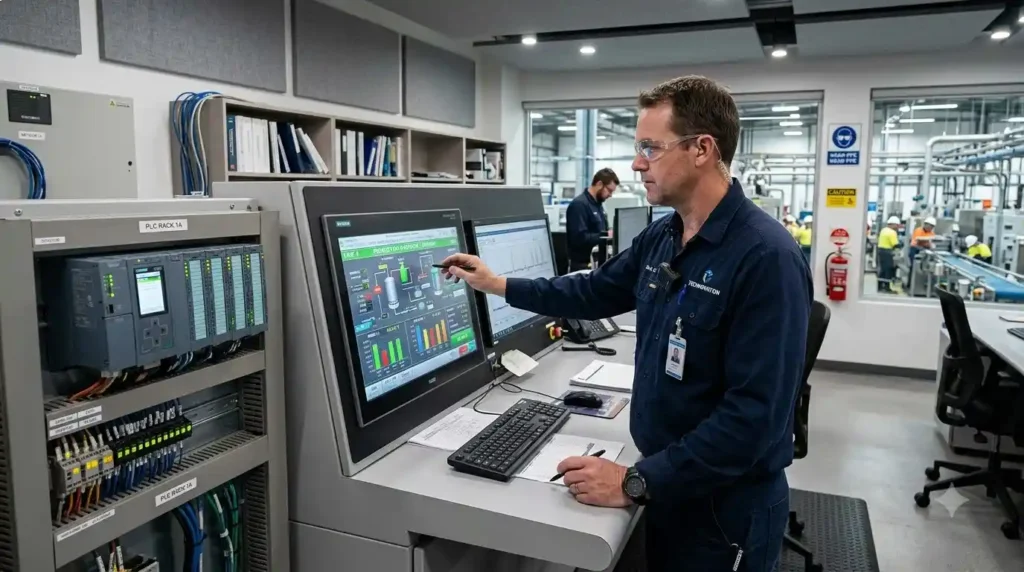
Industrial Automation Systems in Hyderabad PLC panel installed in a manufacturing facility control room

Plenty of factory owners in Hyderabad already know what PLC panels do. The harder question isn’t “what is automation” — it’s “does it make sense for my plant right now, or am I better off running manual control for another two years?” That’s a financial and operational decision, not a technical one, and it deserves a straight answer instead of a generic sales pitch.

This guide is for plant owners and operations managers weighing that decision — looking at what actually triggers a good case for Industrial Automation Systems in Hyderabad, what the real costs and payback timelines look like, and when staying manual is still the smarter call.

Signs Your Plant Is Ready for Automation

You're Losing Production Time to Manual Switching Errors

If operators are manually starting and stopping motors in sequence, human error eventually causes a misstep — wrong start order, a missed interlock, a process step run out of sequence. If this happens often enough to show up in your downtime log, automation removes that variable entirely.

Your Product Quality Depends on Consistency You Can't Guarantee Manually

Pharma and food-processing facilities in particular need precise, repeatable timing and sequencing. If quality control keeps flagging batch-to-batch variation traceable to control timing, that’s a strong signal manual operation has hit its ceiling.

You're Scaling Production and Running Out of Operators

Adding shifts or lines to keep up with manual monitoring gets expensive fast. Automation lets one operator supervise what used to require several, which becomes a real labor-cost argument once your plant crosses a certain size.

You Need Data You Currently Don't Have

If you can’t answer “how many hours did Line 2 run last week” without walking the floor and asking someone, you’re already paying an invisible cost in poor visibility. Automated systems log this data by default.

Downtime Is Costing More Than the Automation Would

This is the number that actually matters. If unplanned downtime from manual-control issues costs more per year than the automation upgrade would, the decision essentially makes itself.

Signs You Can Reasonably Wait

  • Your process is genuinely simple, with few sequencing steps and low error risk
  • Production volume is stable and not expected to scale meaningfully in the next few years
  • Your current downtime is low and not traceable to control or sequencing issues
  • Capital is tied up in a higher-priority investment right now
There’s no engineering reason to automate a process that doesn’t need it. A good Industrial Automation Systems provider should tell you this honestly instead of pushing an upgrade you don’t need yet.

What Automation Actually Costs — and What It Saves

The Upfront Investment

Costs vary with the number of I/O points, the complexity of the process logic, and whether you’re retrofitting an existing panel or starting fresh. A PLC Automation Panel integrated into new construction is typically less expensive than retrofitting automation into an aging manual panel, since retrofits often require rewiring beyond the automation components themselves.

Where the Payback Comes From

  • Reduced downtime from eliminated switching errors and faster fault diagnosis
  • Lower labor cost per shift, since fewer operators are needed for direct monitoring
  • Reduced scrap and rework from tighter process consistency
  • Energy savings, when automation is paired with load management and power factor correction
  • Fewer compliance issues, since automated systems log data auditors increasingly expect to see

Most facilities that automate a genuinely bottlenecked process see payback within a reasonably short window once these savings are added up — though the exact timeline depends heavily on your specific downtime and labor costs, which is why a proper site assessment matters more than a generic industry average.

Retrofit vs. New Installation

Retrofitting an Existing Panel

Retrofitting makes sense when your existing MCC Panel or distribution system is structurally sound but the control logic is outdated. A capable manufacturer can integrate PLC hardware into the existing panel structure without a full rebuild, which keeps cost down but requires careful assessment of whether the existing wiring and enclosure can support the upgrade.

Starting Fresh

If your current panels are aging, undersized for present-day load, or already due for replacement, building automation in from the start is usually more cost-effective than automating something you’ll replace again in a few years anyway.

What to Ask a Provider Before Committing

  1. What specific problem will this solve? A good provider should tie the automation upgrade to a specific, measurable issue in your operation, not a general efficiency pitch.
  2. What’s the realistic payback period for my plant specifically? Ask for a calculation based on your actual downtime and labor figures, not an industry-average number.
  3. Can this be phased? Some plants automate one line first to validate the investment before rolling it out further.
  4. What happens to my existing panel infrastructure? Clarify whether existing ATS Panels, AMF Panels, or distribution panels integrate cleanly with the new automation layer.
  5. What training does my team need? Operators used to manual control need proper handover training, or the investment underperforms simply from underuse.

Common Mistakes Plants Make with Automation Decisions

  • Automating because a competitor did — without a specific bottleneck to solve, the investment often underperforms.
  • Underestimating training time — a system your operators don’t fully understand doesn’t deliver its expected value.
  • Ignoring integration with existing panels — automation bolted onto incompatible infrastructure creates new failure points.
  • Skipping a phased rollout option — going all-in across every line at once increases risk when a smaller pilot could validate the case first.
  • Not budgeting for maintenance — automated systems still need periodic inspection and calibration, not just a one-time installation.

Expert Tips

  • Track your downtime causes for a month before deciding — the data usually makes the automation case clearer than intuition does.
  • Ask for a phased quote so you can validate ROI on one line before committing plant-wide.
  • Prioritize automating the process step causing the most quality variation, not necessarily the most visible one.
  • Factor operator training time into your project timeline, not just the installation schedule.
  • Revisit the decision annually if you decided to wait — production volume and labor costs change, and the math can shift.

Why Choose SM Electricals

SM Electricals designs and integrates Industrial Automation Systems in Hyderabad based on an honest assessment of whether automation actually solves your plant’s specific problem — not a blanket recommendation to upgrade everything at once. Operating from Jeedimetla under CEO Mr. Saisudha Pamidimarri, the team has handled both new-build PLC Automation Panels and retrofits into existing MCC and PCC infrastructure for facilities across Hyderabad, Telangana, and Andhra Pradesh.

If you’re still deciding whether automation makes sense for your operation, a site assessment gives a far more useful answer than an industry-average payback figure. You can review completed automation projects in the gallery or explore the full service range before requesting a consultation.

Questions

Look at your downtime log for switching errors, check whether product consistency issues trace back to manual control, and compare current losses against the likely cost of automating that specific process.
It depends entirely on your current downtime costs and labor allocation. A site assessment based on your actual figures gives a far more accurate answer than a generic industry number.
Often yes, provided the existing enclosure and wiring can structurally support the upgrade. If your panel is already due for replacement, starting fresh is usually more cost-effective long-term.
Yes, a phased rollout is a practical way to validate ROI before committing to a full-plant automation upgrade.
Operators need hands-on training on the new control interface and troubleshooting basics — skipping this reduces the value of the investment significantly.
Automation itself doesn't directly cut power costs, but pairing it with load management and an APFC Panel for power factor correction typically does.
Timelines depend on whether it's a retrofit or new build, and how many I/O points and process steps are involved. A detailed project timeline should come from your provider after a site assessment.
That's a legitimate outcome. A good provider will tell you honestly if your current operation doesn't justify the investment yet, rather than pushing an unnecessary upgrade.

Conclusion

Industrial Automation Systems in Hyderabad aren’t a default upgrade every plant needs immediately — they’re worth it when a specific, measurable problem justifies the investment. Track your actual downtime and labor costs, get a payback estimate based on your real numbers, and decide from there rather than from a general industry trend.

Call-To-Action

Want an honest assessment of whether automation makes sense for your plant right now? Talk to SM Electricals about a site evaluation, or explore the PLC Automation Panel range and more engineering guides on the blog.
Call Now Button