
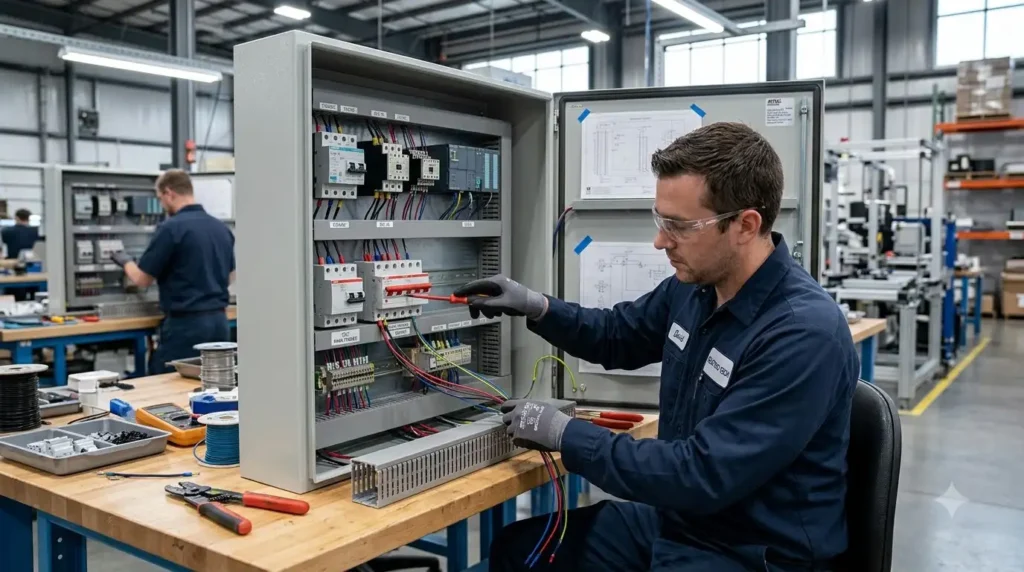
Most buyers never see what happens between signing a purchase order and the panel arriving on-site. That gap gets filled with a lot of engineering work — load calculations, drawing approvals, sheet metal fabrication, wiring, and testing — and how well a Control Panel Manufacturer handles each stage determines whether your panel performs reliably for the next decade or gives you trouble in year two.
This walkthrough breaks down the actual manufacturing process, stage by stage, so procurement managers, project engineers, and plant owners know what questions to ask and what to expect at each checkpoint before the panel ever reaches their facility.
Before any drawing gets made, a competent Control Panel Manufacturer needs your actual electrical load data — connected load, diversity factor, motor ratings, and any future expansion plans. Skipping this step is where most panel problems start. A panel sized against incomplete load information either runs undersized busbars that heat up under load or gets oversized unnecessarily, adding cost without adding value.
Facilities working with EPC contractors should share single-line diagrams and load schedules as early as possible, since revisions after fabrication begins cost both time and money.
Once load data is confirmed, the manufacturer’s design team develops the single-line diagram, general arrangement drawing, and bill of materials. This is the stage where busbar sizing, breaker ratings, cable routing, and protection coordination all get worked out on paper.
A serious Control Panel Manufacturer will send these drawings for client approval before cutting any metal. Reviewing this drawing carefully — checking breaker ratings against your load, confirming spare feeder allowance, verifying enclosure dimensions fit your panel room — saves far more time than catching an error after fabrication starts.
With approved drawings in hand, sheet metal fabrication begins. Enclosure gauge, IP rating, and finish depend on where the panel will be installed — an outdoor feeder pillar needs a different build than an indoor MCC room. Powder coating and rust-proofing at this stage matter more than most buyers realize, since a poorly finished enclosure corrodes faster in humid or dusty industrial environments.
This is also where busbar chambers, cable entry points, and door interlocks get built into the structure, based on the approved general arrangement drawing.
Breakers, contactors, relays, meters, and PLC hardware get mounted according to the approved bill of materials. Wiring follows the control schematic, with each wire numbered and terminated according to standard practice — a detail that makes future troubleshooting dramatically easier for your maintenance team.
For PLC Automation Panels, this stage also includes programming and configuring the logic controller according to the process sequence agreed during design. For panels handling motor control, correct starter and overload relay sizing at this stage protects your equipment from day one.
This is the stage that separates a reliable Control Panel Manufacturer from an assembler cutting corners. Factory acceptance testing (FAT) typically includes:
Clients should ask whether they can witness FAT in person or over video call before dispatch. A manufacturer confident in their build quality will welcome this; one that resists is worth questioning.
Panels are packed to prevent transit damage — bracing internal components, protecting doors and meters, and securing loose parts that could shift during transport. For heavier PCC Panels or MCC Panels, proper lifting points and packaging reduce the risk of misalignment that could show up only after installation.
A manufacturer’s job doesn’t end at dispatch. Installation support includes positioning the panel, connecting incoming and outgoing cables, and running commissioning checks on-site before the panel goes live. For ATS Panels and AMF Panels, this stage includes testing the automatic transfer sequence under simulated mains failure to confirm switchover timing meets specification.
Understanding the manufacturing process gives buyers leverage during vendor evaluation. Instead of comparing quotes on price alone, you can ask a Control Panel Manufacturer specific questions at each stage:
Manufacturers who answer these clearly, with documentation to back it up, are the ones worth shortlisting.
SM Electricals follows this structured process on every panel — from load assessment and drawing approval through fabrication, wiring, factory testing, and on-site commissioning. Working out of Jeedimetla, Hyderabad, under the leadership of CEO Mr. Saisudha Pamidimarri, the team builds PCC, MCC, APFC, PLC Automation, ATS, AMF, and Control Relay Panels for factories, EPC contractors, and infrastructure projects across Telangana and Andhra Pradesh.
As a Control Panel Manufacturer, SM Electricals treats drawing approval and factory acceptance testing as standard practice, not optional extras — which is exactly the kind of process discipline this guide recommends checking for before you commit to any vendor. You can view completed work in the gallery or explore the full product range before requesting a quote.
Ready to discuss your panel requirements in detail? Contact SM Electricals to walk through the design and manufacturing process for your project, or browse the product range and more engineering guides on the blog.
Transform your industrial electrical infrastructure with innovative, reliable, and customized solutions from SM Electricals. Our expert team is ready to help you achieve safer operations, better efficiency, and long-term performance.
Copyright © 2025 Smele. All rights reserved.Powered by Surya Digital Solutions.
WhatsApp us
