Power Automation Solutions in Hyderabad Beyond Manual Load Monitoring

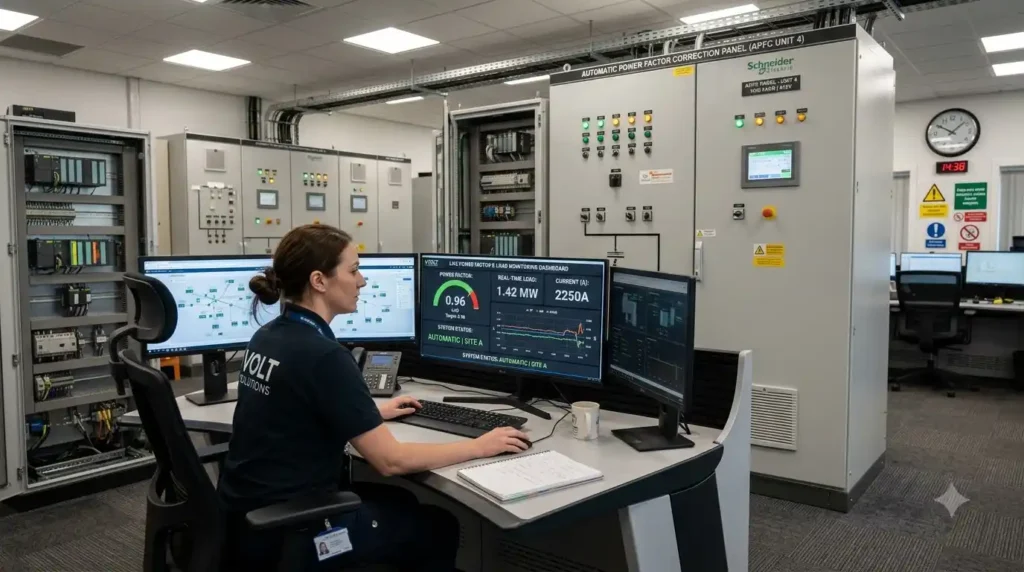
Power Automation Solutions in Hyderabad remote panel monitoring dashboard and automatic power factor correction panel

There’s a meaningful difference between automating a production process and automating the power system feeding it. Process automation gets the attention — PLC panels sequencing machinery, robotic handoffs, sensor-driven quality checks. Power automation is quieter but just as consequential: it’s what keeps voltage stable, catches a developing fault before it trips a breaker, and corrects power factor in real time instead of after the electricity bill arrives.

Power Automation Solutions in Hyderabad cover this side of the operation — automating how power is distributed, monitored, and optimized across a facility, independent of whatever process automation runs downstream. This guide breaks down what power automation actually includes, where it delivers the clearest value, and how to evaluate whether your facility needs it.

What Power Automation Actually Covers

Automatic Power Factor Correction

An APFC Panel continuously monitors power factor and automatically switches capacitor banks in and out to keep it within target range, without requiring manual adjustment. This is one of the most common and fastest-paying forms of power automation, since it directly reduces the penalty charges that show up on industrial electricity bills.

Remote Panel Monitoring

Instead of a technician walking the floor to check panel status, sensors report load, temperature, and fault conditions to a central dashboard in real time. This shortens the gap between a developing problem and someone noticing it, which matters most for issues that build gradually — a loose connection heating up, a phase imbalance creeping past normal range.

Automatic Load Management

Facilities with multiple large loads — compressors, chillers, production lines — can use automated load management to stagger startup sequences and avoid demand spikes that trigger higher tariff slabs or overload the incoming supply. This runs independently of process automation, operating purely at the power distribution level.

Automatic Transfer and Backup Switching

ATS Panels and AMF Panels automatically detect a mains failure and switch to generator backup within seconds, without requiring anyone to notice the outage and manually start a generator. This is power automation in its most direct form — a decision that used to require a person now happens automatically based on sensed conditions.

Substation and Distribution Automation

Larger facilities and industrial parks increasingly automate substation-level functions — fault detection, automatic isolation of a faulted section, and remote breaker operation — reducing how much of a widespread outage a single fault actually causes.

How Power Automation Differs from Process Automation

Process automation, typically built around PLC Automation Panels, controls the sequence and logic of manufacturing operations — when a conveyor starts, how a batch process sequences, what triggers a quality check. Power automation operates one layer below that, managing the electrical supply feeding those processes.

The two often get bundled in conversation, but they solve different problems. A facility can have sophisticated process automation and still be running power distribution manually — checking meters by hand, correcting power factor reactively, responding to outages only after someone notices the lights go out. Power Automation Solutions in Hyderabad specifically address that second layer, and facilities benefit from evaluating it independently of whatever process automation is already in place.

Where Power Automation Delivers the Clearest Value

Facilities with High Power-Factor Penalties

If your electricity bill regularly includes a power-factor penalty, automatic correction typically pays for itself within a reasonably short window by eliminating that charge going forward.

Facilities with Frequent Grid Fluctuations

Industrial zones around Hyderabad that experience regular voltage dips or outages benefit significantly from automated backup switching, since manual generator start introduces delay exactly when continuity matters most.

Multi-Load Facilities Managing Demand Charges

Plants running several large loads that can trigger demand-based tariff penalties benefit from automated load staggering, which keeps peak demand within a target band without requiring manual coordination between shifts.

Facilities Without Visibility into Real-Time Load Data

If your team currently checks load and fault conditions through manual meter readings or physical inspection, remote monitoring closes that visibility gap immediately, often surfacing issues that were previously invisible until they caused a failure.

What to Evaluate Before Investing in Power Automation

  1. Which specific inefficiency are you solving for? Power factor penalties, outage response delay, and demand charge management each call for a different automation investment — identify the actual cost before choosing a solution.
  2. Does your existing panel infrastructure support automation integration? Older panels may need retrofitting or replacement to support monitoring sensors and automated switching.
  3. What data do you actually need visibility into? Remote monitoring scope should match what your team will realistically use, not include every possible metric by default.
  4. How will automation integrate with your existing maintenance process? Automated alerts are only useful if someone is responsible for acting on them.
  5. What’s the realistic payback period for your specific situation? Ask for a calculation based on your actual electricity bill and outage history, not a generic industry estimate.

Common Mistakes Facilities Make with Power Automation

  1. Automating without addressing the underlying issue — remote monitoring alone doesn’t fix a facility’s recurring power quality problems; it just makes them visible faster.
  2. Assuming process automation covers power automation too — a plant can have advanced PLC control and still be exposed to unmanaged power factor penalties or slow outage response.
  3. Skipping integration planning with existing panels — bolting automation onto incompatible infrastructure creates new points of failure.
  4. Not assigning responsibility for monitoring alerts — a dashboard nobody checks provides no real benefit over the manual process it replaced.
  5. Underestimating retrofit complexity — older panels sometimes need more extensive rework than buyers initially expect to support automation integration.

Expert Tips

  • Pull your last twelve months of electricity bills before evaluating power automation — power factor penalties and demand charges are usually visible right there in the billing detail.
  • Prioritize automating the layer causing the most measurable cost first, rather than automating everything at once.
  • Confirm which team member owns responsibility for acting on automated alerts before the system goes live.
  • Ask your provider for a phased automation plan if budget is a constraint — automatic power factor correction alone often delivers strong ROI as a starting point.
  • Revisit your power automation scope whenever production volume or facility layout changes meaningfully.

Why Choose SM Electricals

SM Electricals designs Power Automation Solutions in Hyderabad around the actual inefficiency a facility is dealing with — whether that’s power factor penalties, slow outage response, or a lack of real-time load visibility — rather than a one-size-fits-all automation package. Based in Jeedimetla under CEO Mr. Saisudha Pamidimarri, the team builds APFC, ATS, and AMF panels engineered for automated response, and supports integration into existing distribution infrastructure across Hyderabad, Telangana, and Andhra Pradesh.

If your facility is losing money to power factor penalties or exposed to outage-related downtime, a site assessment identifies exactly which layer of power automation delivers the fastest return. Review the full service range or explore completed projects in the gallery before requesting a consultation.

Latest Trends in Power Automation

  • Cloud-based energy dashboards, giving facility managers remote access to load, power factor, and fault data from anywhere
  • Predictive load management, using historical consumption patterns to anticipate demand spikes before they trigger tariff penalties
  • Integration with renewable and battery storage systems, automating how a facility switches between grid, backup, and stored power
  • AI-assisted fault prediction, flagging developing electrical issues based on gradual pattern changes rather than waiting for a hard failure
  • Standardized data protocols, making it easier for power automation systems to integrate with existing building management platforms

Questions

Power automation manages electrical distribution — power factor correction, backup switching, load monitoring — while process automation controls manufacturing sequences and machinery logic, typically through PLC systems.
Yes, it's one of the most common and fastest-paying forms of power automation, continuously adjusting capacitor banks without manual intervention.
It depends on the age and condition of existing infrastructure — some panels can be retrofitted with monitoring and automation components, while others may need replacement to support integration properly.
Properly configured ATS and AMF systems typically switch to backup power within seconds of detecting a mains failure, far faster than manual generator start.
Typical data includes load levels, temperature readings, power factor, and fault conditions, reported in real time to a central dashboard.
Automatic power factor correction and demand management can reduce specific charges directly, while remote monitoring reduces costs indirectly by catching issues before they cause downtime.
Review your recent electricity bills and outage history — whichever issue is costing the most, whether power factor penalties or downtime from slow outage response, is usually the clearest place to start.
Yes, many facilities start with automatic power factor correction or backup switching and expand to broader monitoring and load management over time as budget allows.

Conclusion

Power Automation Solutions in Hyderabad address a layer of operational efficiency that’s easy to overlook when the focus stays on process automation alone. Whether it’s automatic power factor correction, faster backup switching, or real-time load visibility, identifying the specific inefficiency costing your facility money is the clearest path to a power automation investment that actually pays for itself.

Call-To-Action

Curious which power automation investment would deliver the fastest return for your facility? Talk to SM Electricals about a site assessment, or explore the APFC and ATS/AMF panel range and more engineering guides on the blog.
Call Now Button