Electrical Maintenance Services in Hyderabad What a Proper AMC Includes

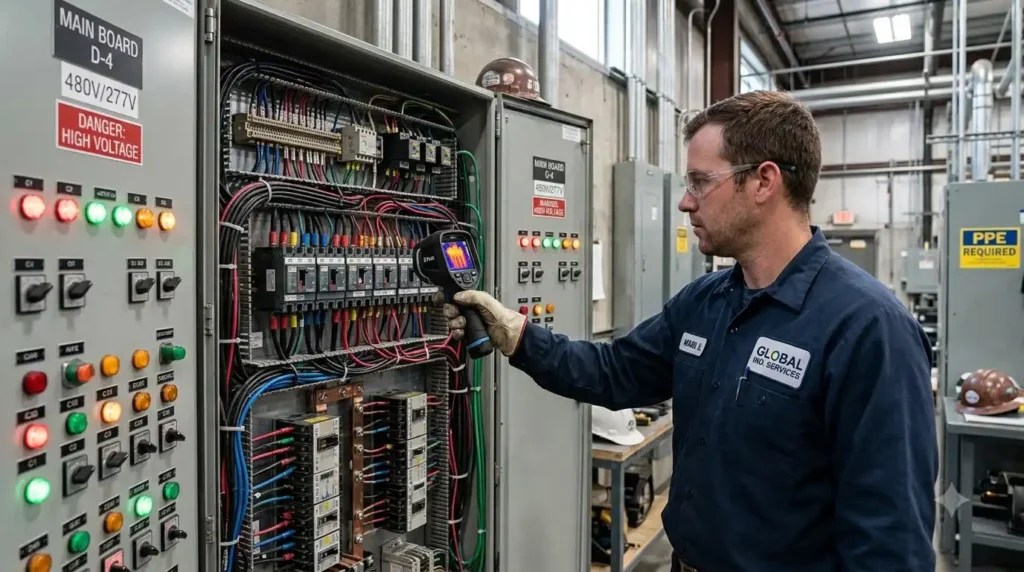
Electrical Maintenance Services in Hyderabad technician performing thermal scanning on an industrial control panel

The panel that fails usually gave warning signs first — a connection running hotter than normal, a relay drifting out of calibration, a breaker that’s been tripping slightly more often than it used to. Facilities that skip regular maintenance rarely notice these signs until the failure actually happens, at which point the cost is downtime, not just a repair bill.

Electrical Maintenance Services in Hyderabad exist to catch exactly these warning signs early. This guide covers what a proper maintenance contract should include, how often different checks need to happen, and what separates a maintenance provider who genuinely prevents failures from one who just shows up for a scheduled visit.

Why Maintenance Gets Skipped and Why That's Expensive

Maintenance is easy to defer because nothing visibly breaks when it’s skipped, at least not immediately. That’s exactly the problem. Electrical components degrade gradually — connections loosen from thermal cycling, insulation weakens with age and heat exposure, relay contacts wear from repeated switching — and none of this shows up until it causes a failure.

The cost comparison is straightforward once you look at it directly. A scheduled maintenance visit costs a fraction of an unplanned production stoppage, and far less than replacing a panel that failed catastrophically because a developing fault went unnoticed for months.

What Electrical Maintenance Services Should Actually Include

Thermal Scanning

Infrared thermal imaging identifies connections and components running hotter than normal — the single most common early warning sign of a developing electrical fault. A loose busbar connection, an overloaded circuit, or a failing contactor all show up as heat before they show up as failure.

Connection Tightness Checks

Vibration and thermal cycling gradually loosen electrical connections over time. Periodic torque checks on busbar and terminal connections catch this before a loose connection generates enough heat to become a fire risk or cause a fault.

Insulation Resistance Testing

Insulation degrades with age, heat, and moisture exposure. Regular insulation resistance testing catches weakening insulation before it fails and causes a short circuit or ground fault.

Relay and Protection Device Calibration

Protection relays need to trip at the correct threshold to actually protect equipment. Relays that have drifted out of calibration either trip unnecessarily, causing nuisance shutdowns, or fail to trip when they should, exposing equipment to damage during an actual fault.

Breaker and Contactor Functional Testing

Breakers and contactors that aren’t exercised regularly can seize or fail to operate correctly when actually called on. Functional testing confirms they’ll perform when needed, not just that they look fine sitting idle.

Cleaning and Dust Removal

Industrial environments accumulate dust inside panel enclosures, which affects both cooling and insulation. Regular cleaning, particularly in dusty facilities, is a simple maintenance step that prevents several downstream problems.

Battery Backup Testing

For panels connected to ATS or AMF systems, battery backup needs periodic testing to confirm it will actually hold and deliver power during a mains failure — a battery that hasn’t been tested in months carries real risk of not performing when needed.

How Often Different Maintenance Tasks Should Happen

  • Thermal scanning — quarterly for critical panels, semi-annually for lower-risk circuits
  • Connection tightness checks — annually at minimum, more frequently in high-vibration environments
  • Insulation resistance testing — annually, or more often for panels in humid or corrosive environments
  • Relay calibration — annually, aligned with statutory compliance requirements where applicable
  • Functional breaker testing — semi-annually
  • Cleaning — frequency depends heavily on the facility’s dust and environmental conditions, ranging from monthly to quarterly

A maintenance contract that treats every task on a single fixed schedule regardless of criticality usually isn’t accounting for how differently these components actually degrade.

What to Look for in an Annual Maintenance Contract

Clear Scope Definition

The contract should specify exactly which panels and equipment are covered, what tasks are performed at each visit, and how often each task occurs — not a vague reference to “regular maintenance.”

Documented Reporting

Every maintenance visit should produce a written report — what was checked, what was found, and what (if anything) needs follow-up. This documentation matters for compliance audits and for tracking a panel’s condition trend over time.

Emergency Response Terms

Scheduled maintenance is only half the picture. Confirm what response time the contract guarantees for emergency breakdown support, and whether that’s a genuine commitment or just an informal expectation.

Spare Parts Availability

Ask whether the provider stocks common spare parts locally for the specific component brands in your panels, since a maintenance visit that identifies a failing part is only useful if the replacement is actually available quickly.

Escalation and Follow-Up Process

If a maintenance visit identifies a developing issue that needs more than routine attention, the contract should define how that gets escalated and resolved, rather than leaving it as an informal conversation.

Signs Your Current Maintenance Program Isn't Working

  • Breakdowns keep happening despite a maintenance contract being in place
  • Maintenance visits produce no written documentation of what was checked
  • The same issues get flagged repeatedly without ever being resolved
  • Response time during an actual emergency doesn’t match what was promised in the contract
  • Nobody can tell you when the last thermal scan or insulation test was actually performed

Any of these is a sign the maintenance relationship needs a serious conversation, or a different provider entirely.

Benefits of a Properly Structured Maintenance Program

  • Fewer unplanned breakdowns and the production losses that come with them
  • Longer service life from panels and components, since developing issues get caught early
  • Simplified compliance documentation for statutory inspections
  • Better budget predictability, since scheduled maintenance costs are known in advance versus unpredictable emergency repair costs
  • A maintenance history that supports better decisions about when to repair versus replace aging equipment

Common Mistakes Facilities Make with Electrical Maintenance

  1. Treating maintenance as optional overhead — skipping it to save cost usually shifts that cost to more expensive emergency repairs later.
  2. Signing a vague contract without task-level detail — without specifics, it’s impossible to verify the maintenance is actually thorough.
  3. Not reviewing maintenance reports — reports that get filed without review miss the early warning signs they were meant to catch.
  4. Assuming all panels need identical maintenance frequency — critical panels feeding continuous processes typically warrant more frequent attention than lower-risk circuits.
  5. Switching providers without transferring maintenance history — losing the condition trend data on your equipment makes it harder for a new provider to spot developing issues quickly.

Expert Tips

  • Request sample maintenance reports from a provider before signing a contract, so you know what documentation to expect.
  • Prioritize thermal scanning frequency for your most critical panels — it catches the widest range of developing issues relative to its cost.
  • Keep a maintenance log even if your provider also documents visits, so you have an independent record for compliance and equipment lifecycle decisions.
  • Review your maintenance contract annually and adjust scope if your facility’s equipment or criticality has changed.
  • Don’t wait for a contract renewal to raise concerns about response time or report quality — address it as soon as it becomes a pattern.

Why Choose SM Electricals

SM Electricals provides Electrical Maintenance Services in Hyderabad structured around documented, task-specific schedules rather than a generic recurring visit. Based in Jeedimetla under CEO Mr. Saisudha Pamidimarri, the team supports thermal scanning, connection checks, insulation testing, and relay calibration for PCC, MCC, APFC, ATS, AMF, and control relay panels across Hyderabad, Telangana, and Andhra Pradesh, with written reporting after every visit and defined emergency response commitments.

For facilities currently without a structured maintenance program, or unsatisfied with the documentation and responsiveness of a current provider, a maintenance assessment identifies exactly what your equipment needs and how often. Review the full service range or see the team’s work in the gallery before requesting a consultation.

Latest Trends in Electrical Maintenance

  • Condition-based maintenance, using sensor data to trigger service visits based on actual equipment condition rather than a fixed calendar schedule
  • Digital maintenance logs, replacing paper records with searchable digital documentation accessible for compliance audits
  • Remote thermal monitoring, allowing some early warning detection between scheduled physical visits
  • Predictive failure analysis, using historical maintenance data to flag components approaching end of reliable service life
  • Bundled installation-and-maintenance contracts, with more facilities pairing new panel installation with a maintenance agreement from day one rather than treating it as a separate later decision

Questions

It depends on the component and criticality — thermal scanning quarterly for critical panels, insulation and connection checks at least annually, with more frequent attention in harsh environments.
A proper AMC should cover thermal scanning, connection tightness checks, insulation resistance testing, relay calibration, functional breaker testing, and documented reporting after each visit.
Cost depends on the number and complexity of panels covered and visit frequency. A detailed proposal based on your specific equipment gives a more accurate figure than a generic estimate.
Preventive maintenance follows a scheduled program to catch developing issues early, while emergency maintenance responds to an actual breakdown — a good contract includes clear terms for both.
Yes, maintenance scope and frequency should reflect the specific panels and their criticality within your facility, rather than a uniform schedule applied to everything.
A properly structured contract defines an escalation process for follow-up repairs or replacement, rather than leaving it as an informal, undocumented conversation.
Check whether visits produce detailed written reports, whether flagged issues actually get resolved, and whether breakdowns have decreased since the contract started.
Yes, SM Electricals combines scheduled preventive maintenance with defined emergency response support for facilities across Hyderabad and the surrounding region.

Conclusion

Electrical Maintenance Services in Hyderabad work when they’re structured around specific, documented tasks and realistic response commitments — not a vague recurring visit. The cost of proper maintenance is consistently lower than the cost of the breakdowns it prevents, which makes it one of the more straightforward investments a facility can make in its own reliability.

Call-To-Action

Looking to set up or improve your facility’s maintenance program? Talk to SM Electricals about a maintenance assessment, or explore the full service range and more engineering guides on the blog.
Call Now Button