How to Choose the Right Electrical Control Panel Manufacturer for Your Facility

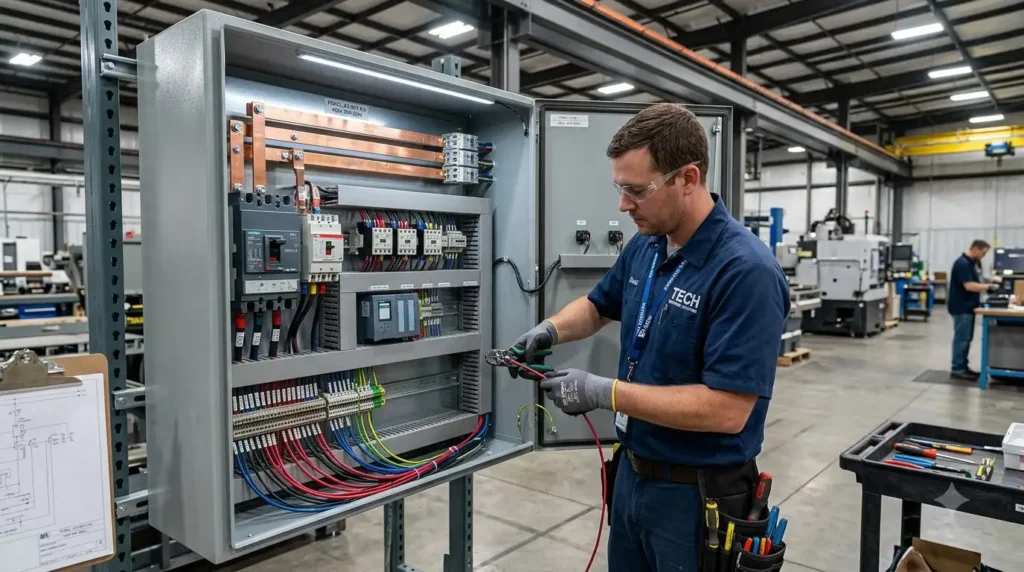
Electrical Control Panel Manufacturer fabricating industrial PCC and MCC panels at SM Electricals Hyderabad facility

A factory floor stops the moment its panel fails. Not the machines, not the operators — the panel. Every motor starter, every automation loop, every backup generator routes through it, so the decision about which Electrical Control Panel Manufacturer builds that panel carries more weight than most procurement teams give it upfront.

Plant managers, EPC contractors, and facility engineers across Hyderabad, Telangana, and Andhra Pradesh often shortlist vendors on price alone, then discover during commissioning that busbar sizing was wrong, cable glands were mismatched, or the enclosure rating didn’t suit the shop-floor environment. This guide walks through what actually separates a dependable Electrical Control Panel Manufacturer from one that will cost you downtime later — covering technical evaluation, compliance checks, and the buying mistakes that trip up even experienced procurement managers.

Why the Manufacturer Matters More Than the Panel

A control panel is only as good as the engineering discipline behind it. Two panels can look identical from the outside — same enclosure, same paint finish — and still perform completely differently once loaded. The difference comes down to how the Electrical Control Panel Manufacturer approaches busbar current density, wire routing, thermal management, and component sourcing.

Industrial buyers who treat panel manufacturing as a commodity purchase tend to face three recurring problems: premature component failure, inconsistent voltage regulation, and panels that can’t be expanded when the plant scales up. A manufacturer with real fabrication depth designs for the next five years of load growth, not just the day-one specification sheet.

What Separates Experienced Manufacturers from Assemblers

Many vendors in the market are assemblers — they buy pre-made components and bolt them into an enclosure. A genuine Electrical Control Panel Manufacturer does more:

  • Designs the single-line diagram and control logic in-house
  • Selects busbar and cable sizing based on actual load calculations, not guesswork
  • Runs factory acceptance testing (FAT) before dispatch
  • Fabricates enclosures to IP ratings suited to the installation environment
  • Offers after-commissioning support and spare-part availability

If a supplier can’t walk you through their design process or show you a factory acceptance test report, that’s a signal to keep evaluating other vendors.

Types of Panels You Should Understand Before You Buy

Procurement decisions get easier once you know which panel category your application actually needs.

Power and Motor Control Panels

PCC Panels manage bulk power distribution at the incoming supply point, while MCC Panels handle motor starting, protection, and control downstream. Facilities running multiple pumps, compressors, or conveyor motors typically need both working together.

Automation and Process Control

PLC Automation Panels bring programmable logic into the picture, letting a facility automate sequencing, interlocks, and process monitoring instead of relying on manual switching. This is where a manufacturer’s automation engineering experience becomes the deciding factor — programming errors in a PLC panel are far costlier to fix on-site than at the factory stage.

Power Backup and Continuity Panels

ATS Panels and AMF Panels keep critical operations running through a mains failure by switching to generator backup automatically. Hospitals, data-adjacent facilities, and continuous-process plants depend on these being engineered with fast, reliable transfer logic.

Efficiency and Protection Panels

An APFC Panel corrects power factor and reduces the penalty charges that show up on industrial electricity bills, while Control Relay Panels protect substations and switchgear from fault conditions. Fire safety panels round out a complete industrial electrical setup by handling early detection and alarm activation.

Key Factors to Evaluate Before Choosing an Electrical Control Panel Manufacturer

1. Technical Specifications and Load Calculations

Ask the manufacturer to walk through their load calculation method, not just hand over a quote. A competent Electrical Control Panel Manufacturer will size busbars, breakers, and cable runs against your actual connected load plus a safety margin for future expansion — not a generic template pulled from a previous project.

2. Compliance and Safety Standards

Industrial panels in India should meet IS/IEC standards for switchgear and control assemblies, along with proper IP-rated enclosures for the installation environment. Ask for test certificates, not verbal assurances. A manufacturer that can’t produce documentation on request usually can’t produce consistent quality either.

3. Component Sourcing

Find out which brands of breakers, contactors, relays, and meters the manufacturer uses by default. Reputable component brands cost more upfront but fail less often, and spare parts stay available for years — a real consideration when your plant needs a replacement part fast during a breakdown.

4. Customization Capability

No two facilities have identical electrical loads or floor layouts. A manufacturer who only offers fixed panel configurations will force your project to adapt to their product instead of the other way around. Ask to see examples of customized panels they’ve delivered for applications similar to yours.

5. Factory Testing and Quality Control

Before dispatch, panels should go through functional testing, insulation resistance checks, and visual inspection against the approved drawing. Ask whether you can witness a factory acceptance test, either in person or over video, before the panel ships to your site.

6. Delivery Timelines and Project Management

Panel manufacturing lead times vary depending on component availability and panel complexity. A manufacturer who gives you a realistic, honest timeline — and communicates proactively if something shifts — is easier to plan a project around than one who overpromises at the quotation stage.

7. After-Sales Support and Maintenance

Panels need periodic maintenance: thermal scanning, tightness checks on connections, and relay calibration. Confirm whether the manufacturer offers ongoing maintenance support or only handles the initial installation and walks away.

Benefits of Working with an Established Electrical Control Panel Manufacturer

  • Reduced risk of unplanned downtime from component failure
  • Panels engineered for your actual load profile, not a generic template
  • Documented compliance that simplifies statutory inspections
  • Faster fault diagnosis because the panel layout follows a logical, well-documented design
  • A single point of accountability for design, fabrication, and after-sales support
  • Scalability built in, so expansion doesn’t mean starting from scratch

Why Choose SM Electricals

SM Electricals has built its reputation in Jeedimetla, Hyderabad, by treating every panel as an engineering project rather than a fabrication order. Under the leadership of CEO Mr. Saisudha Pamidimarri, the team designs and manufactures PCC, MCC, APFC, PLC automation, ATS, AMF, and control relay panels for factories, EPC contractors, and infrastructure developers across Hyderabad, Telangana, and Andhra Pradesh.

What sets SM Electricals apart as an Electrical Control Panel Manufacturer is the combination of precision engineering, a skilled in-house workforce, and a safety-first approach to every build. Panels are designed around the client’s actual load requirements, tested before dispatch, and backed by after-sales support that doesn’t disappear once the invoice is paid. You can see completed projects in the gallery or review the full product range before requesting a quote.

Buyers who’ve worked with SM Electricals consistently point to the same things: technical clarity during the design stage, adherence to safety standards, and dependable delivery timelines — the exact factors this guide recommends checking before you commit to any manufacturer.

Latest Industry Trends in Electrical Control Panel Manufacturing

Panel manufacturing in India is shifting in a few clear directions right now:

  • IoT-enabled monitoring — panels increasingly include sensors that report load, temperature, and fault conditions to a remote dashboard, cutting the time it takes to catch a developing problem.
  • Energy-efficiency focus — with industrial power tariffs rising, more facilities are pairing APFC correction with load management systems to reduce billed demand.
  • Modular panel design — manufacturers are building panels in sections that can be expanded without a full rebuild, which matters for facilities planning phased growth.
  • Stricter safety compliance — insurance and statutory audits are pushing buyers to demand better-documented testing records than they did five years ago.
  • Shorter lead-time expectations — EPC contractors are increasingly favoring manufacturers who can commit to and hold realistic delivery schedules over those offering the lowest quote.

An Electrical Control Panel Manufacturer that’s tracking these shifts will already be building panels with monitoring points, modular busbar sections, and efficiency components as standard practice, not as an expensive add-on you have to request separately.

Common Mistakes Buyers Make When Selecting a Manufacturer

  1. Choosing on price alone — the cheapest quote often means thinner-gauge sheet metal, budget-brand components, or skipped testing steps.
  2. Skipping the site visit or factory tour — you can learn more about a manufacturer’s quality control by walking their shop floor than by reading their brochure.
  3. Not verifying certifications — assuming compliance instead of asking for documentation leads to problems during statutory inspection.
  4. Ignoring future load growth — panels sized exactly to today’s load leave no room for expansion, forcing an expensive re-do later.
  5. Overlooking after-sales support — a low upfront price loses its appeal fast if there’s no one to call when a relay trips at 2 a.m.
  6. Rushing the technical review — approving drawings without checking busbar ratings, cable sizing, and protection coordination against your actual load data.

Expert Tips for Industrial Buyers

  • Request the manufacturer’s single-line diagram before approving any order — it tells you more about their engineering rigor than the quotation does.
  • Compare warranty terms carefully; some manufacturers only cover components, not workmanship.
  • Ask for references from clients in a similar industry so you can verify real-world performance, not just marketing claims.
  • Budget for periodic maintenance from day one instead of treating it as an unplanned future cost.
  • Confirm spare-part lead times for the specific component brands used in your panel before you need them urgently.

Questions

It depends on your load profile and process requirements. A facility running multiple motors typically needs MCC panels, while one focused on power quality needs APFC correction. A qualified Electrical Control Panel Manufacturer will assess your load data and recommend the right combination rather than selling a fixed package.
Look for compliance with relevant IS/IEC switchgear standards, proper IP-rated enclosure documentation, and factory test certificates for the specific panel you're ordering.
Cost depends on panel size, component brands, automation complexity, and customization level. Getting a detailed quote based on your actual single-line diagram gives a far more accurate figure than a generic price estimate.
Lead times vary with component availability and design complexity, generally ranging from a couple of weeks for standard panels to longer for heavily customized or large-capacity builds. Always confirm a realistic timeline in writing before ordering.
Routine maintenance includes thermal scanning of connections, tightness checks, insulation resistance testing, and relay calibration, usually on a quarterly or half-yearly schedule depending on load intensity.
Yes. An experienced Electrical Control Panel Manufacturer can design panels around unusual load combinations, space constraints, or environmental conditions rather than forcing a standard configuration.
Evaluate their design process, request factory test documentation, check component sourcing, and ask for references from similar-scale projects before finalizing.
Yes, SM Electricals supports clients through design, fabrication, installation, and ongoing maintenance, keeping a single point of contact throughout the panel's operating life.

Conclusion

Selecting an Electrical Control Panel Manufacturer isn’t a line item to rush through — it’s a decision that determines how much downtime, rework, and unplanned cost your facility deals with for years afterward. Evaluate technical capability, compliance documentation, component quality, and after-sales support before price, and you’ll end up with a panel built to actually run your operation, not just pass an initial inspection.

Call-To-Action

Planning a new panel or replacing an aging one? Get in touch with SM Electricals for a technical consultation and quote based on your facility’s actual load requirements. Explore the complete product range or browse more engineering insights on the SM Electricals blog.

Call Now Button