
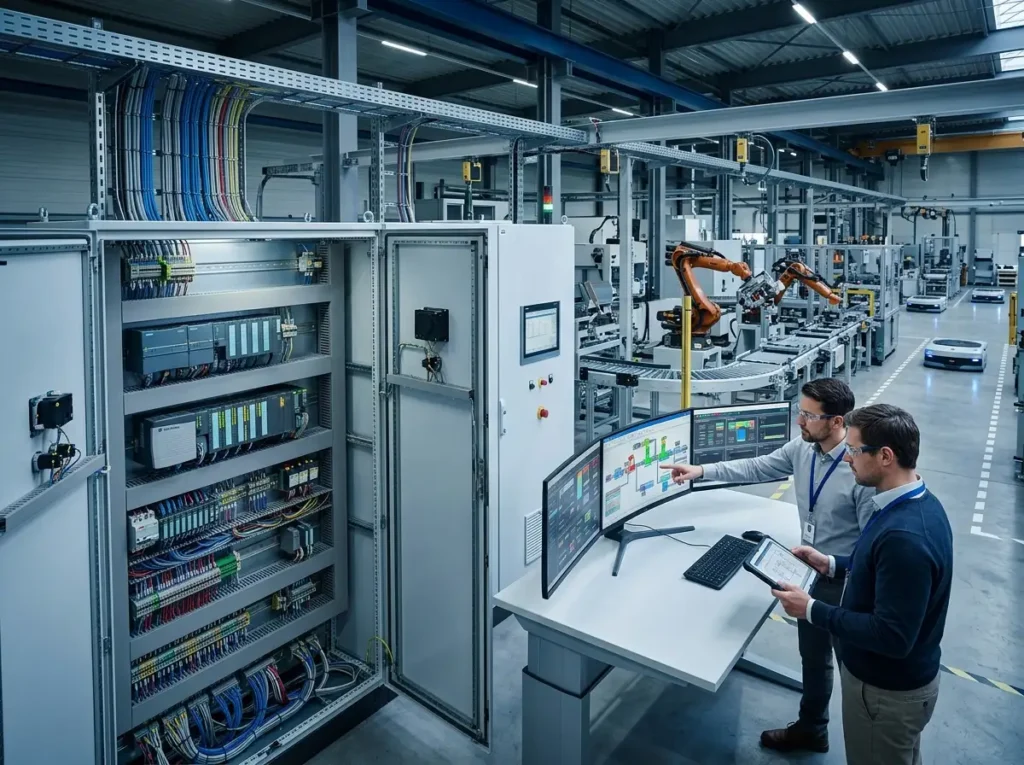
The industrial sector is undergoing a major transformation driven by automation, digitalization, and intelligent control technologies. As production demands increase and operational processes become more complex, industries require systems that can deliver precision, reliability, and efficiency. Traditional control methods often struggle to meet these requirements, leading organizations to adopt advanced automation solutions.
One of the most important technologies powering modern industrial automation is the PLC Automation System. PLC, or Programmable Logic Controller, is a specialized industrial computer designed to monitor inputs, execute programmed instructions, and control outputs automatically. PLCs serve as the foundation of industrial automation by enabling precise control of machines, processes, and production systems.
SM Electricals provides advanced PLC Automation Systems for Industrial Control that help industries improve productivity, reduce operational costs, enhance safety, and achieve higher levels of automation. By integrating PLC technology into industrial operations, organizations can create intelligent systems capable of responding quickly and accurately to changing operational requirements.
Modern industrial facilities depend on numerous machines and processes working together efficiently. Managing these operations manually can be difficult, especially when accuracy, speed, and consistency are critical. PLC Automation Systems for Industrial Control simplify this challenge by automating decision-making and process control.
A PLC continuously receives information from sensors and input devices, processes that information according to a programmed logic sequence, and then controls equipment such as motors, pumps, valves, conveyors, and production machinery.
Unlike traditional relay-based control systems, PLCs offer flexibility, scalability, and faster processing capabilities. They can be programmed to perform complex operations while adapting to changing production requirements.
These capabilities make PLCs an essential component of modern industrial automation.
Industrial competition continues to increase, placing greater pressure on organizations to improve efficiency and productivity. Manual processes often introduce inconsistencies, delays, and human errors that impact operational performance.
PLC Automation Systems for Industrial Control help eliminate these challenges by providing accurate and reliable control over industrial processes. Automated systems can operate continuously with minimal intervention, ensuring consistent performance and improved output quality.
Automation allows industries to optimize resources while maintaining high levels of operational performance.
Manufacturing facilities often involve multiple interconnected processes that must operate in precise coordination. PLCs help manage these processes efficiently by controlling equipment based on programmed logic and real-time operational data.
In production environments, PLCs coordinate machine operations, monitor production status, and ensure that manufacturing sequences are executed correctly.
By automating these processes, manufacturers can achieve higher throughput while maintaining product consistency.
Motors are among the most widely used components in industrial facilities. Effective motor management is essential for maintaining operational efficiency and reducing energy consumption.
PLC Automation Systems for Industrial Control provide advanced motor control capabilities that improve performance and reliability.
Intelligent motor control helps industries reduce operating costs while improving overall system performance.
Process industries such as pharmaceuticals, food processing, chemicals, water treatment, and manufacturing require precise control over operational parameters. PLCs provide the accuracy and reliability needed to manage these processes effectively.
A PLC Automation Systems continuously monitors process variables and makes automatic adjustments to maintain desired operating conditions.
These applications help organizations maintain consistent product quality and operational efficiency.
Modern industrial operations require real-time access to operational information. Without accurate data, decision-making becomes slower and less effective.
PLC Automation Systems for Industrial Control provide real-time visibility into machine performance, production status, and system conditions.
Access to real-time information enables organizations to respond quickly to changing operational conditions.
Equipment failures can significantly impact productivity and profitability. PLCs help reduce these risks by continuously monitoring system performance and detecting abnormal conditions.
ModernPLC Automation Systems include advanced diagnostic features that identify faults and generate alerts before problems escalate.
These capabilities support proactive maintenance strategies and improve overall system availability.
PLC Automation Systems are often integrated with SCADA systems and industrial communication networks to create comprehensive automation solutions.
This integration enables centralized monitoring, advanced analytics, and coordinated control across multiple systems and locations.
Integration allows organizations to build highly connected and intelligent industrial environments.
Energy efficiency has become a major focus for industrial organizations seeking to reduce operating costs and improve sustainability.
PLC Automation Systems for Industrial Control contribute to energy optimization by controlling equipment more efficiently and reducing unnecessary energy consumption.
These improvements help organizations achieve both financial and environmental objectives.
Industrial automation continues to evolve rapidly, andPLC Automation Systems technology remains at the center of this transformation. Future PLC systems will incorporate advanced technologies such as artificial intelligence, machine learning, Industrial IoT, and cloud connectivity.
These innovations will enable more intelligent decision-making, predictive maintenance, and autonomous process optimization.
These developments will further strengthen the role of PLCs in modern industrial environments.
As industries continue to pursue higher levels of efficiency, productivity, and reliability, automation technologies will play an increasingly important role.PLC Automation Systems for Industrial Control provide the flexibility, intelligence, and precision required to manage complex industrial operations effectively.
SM Electricals delivers advanced PLC Automation Systems for Industrial Control that help organizations improve operational performance, reduce costs, enhance safety, and support long-term growth. Through intelligent automation and real-time control, PLC systems create a strong foundation for future-ready industrial operations and sustainable business success.
A PLC Automation System is a programmable controller that automatically monitors and controls industrial machines and processes for efficient operations.
They automate repetitive tasks, reduce human errors, improve process accuracy, and ensure consistent production performance.
They are widely used in manufacturing plants, conveyor systems, packaging lines, water treatment facilities, and process industries.
Yes, PLC systems optimize machine operations, manage loads efficiently, and reduce unnecessary energy usage, helping lower operating costs.
PLC-SCADA integration enables real-time monitoring, centralized control, faster fault detection, and improved decision-making across industrial operations.
Transform your industrial electrical infrastructure with innovative, reliable, and customized solutions from SM Electricals. Our expert team is ready to help you achieve safer operations, better efficiency, and long-term performance.
Copyright © 2025 Smele. All rights reserved.Powered by Surya Digital Solutions.
WhatsApp us
